Showing posts with label Thinking Activity. Show all posts

Monday, July 18, 2022

Derrida and Deconstruction

 Derrida and Deconstruction

This blog is a response to the assigned  thinking activity task by our professor Dr. Dilip Barad sir. In this blog I am going to present my understanding of 'Deconstruction' as well as deconstruct a poem, 'The Solider' by Rupert Brooke.


About the Author: 


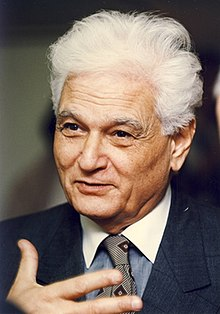
Jacques Derrida  was an Algerian-born French philosopher best known for developing a form of semiotic analysis known as deconstruction, which he analyzed in numerous texts, and developed in the context of phenomenology. He is one of the major figures associated with post-structuralism and postmodern philosophy.

During his career, Derrida published more than 40 books, together with hundreds of essays and public presentations. He had a significant influence on the humanities and social sciences, including philosophy, literature, law, anthropology, historiography, applied linguistics, sociolinguistics, psychoanalysis, architecture, and political theory.


Let's look at the meaning of the term deconstruction in a simpler way.

This image is of a building which is not symmetrical, in architecture or construction field they also call it 'Deconstruction'. Just by looking at the simple example of architecture we can say Deconstruction is not Destruction but it is creation, which is already proved by many critics.


What is Deconstruction:

The term deconstruction refers to approaches to understanding the relationship between text and meaning. It was originated by the philosopher Jacques Derrida, who defined it as a turn away from Platonism's ideas of "true" forms and essences which take precedence over appearances, instead considering the constantly changing complex function of language, making static and idealist ideas of it inadequate. Deconstruction instead places emphasis on the mere appearance of language in both speech and writing, or suggests at least that essence as it is called is to be found in its appearance, while it itself is "undecidable", and everyday experiences cannot be empirically evaluated to find the actuality of language.

Paul de Man, a member of the Yale School and a prominent practitioner of deconstruction as he understood it. His definition of deconstruction is that, 
"it's possible, within text, to frame a question or undo assertions made in the text, by means of elements which are in the text, which frequently would be precisely structures that play off the rhetorical against grammatical elements."

Deconstruction refers to the pursuit of a text's meaning to the point of exposing the implied contradictions and internal oppositions upon which it is built, supposedly demonstrating that those foundations are irreducibly complex, unstable, or impossible. It is a method that can be used in philosophy, literary analysis, and even scientific writing analysis. Deconstruction generally attempts to demonstrate that a text is not a discrete whole, but rather contains several irreconcilable and contradictory meanings; that any text thus has more than one interpretation; that the text itself inextricably links these interpretations; that the incompatibility of these interpretations is irreducible; and thus that an interpretative reading cannot go beyond a certain point.

Deconstruction of a Poem:

The Soldier by Rupert Brooke

If I should die, think only this of me:
That there’s some corner of a foreign field
That is for ever England. There shall be
In that rich earth a richer dust concealed;
A dust whom England bore, shaped, made aware,
Gave, once, her flowers to love, her ways to roam,
A body of England’s, breathing English air,
Washed by the rivers, blest by suns of home.
And think, this heart, all evil shed away,
A pulse in the eternal mind, no less
Gives somewhere back the thoughts by England given;
Her sights and sounds; dreams happy as her day;
And laughter, learnt of friends; and gentleness,
In hearts at peace, under an English heaven. 


Rupert Brooke is a very famous poem and it has served very well as a patriotic or a nationalist poem. Here we are going to deconstruct this poem by trying to find possible biases and binary oppositions in this poem. 

Bias:

We are well aware that this poem is patriotic poem and that's where its bias is created, we can read that the whole poem is talking about nationalism the voice of the speaker is nationalist. Let's say for example the lines,
"If I should die, think only this of me:
That there’s some corner of a foreign field
That is for ever England"

Its not just this line but the whole pome is only talking about  England, so we can say that the poem is England centric poem and creates many biases against nations other than England. 

Binary:

A division into two groups or classes that are considered diametrically opposite. (Definition)

If I should die...
The very first words of this poem are speaking of 'I' which means a human and in later poem speaker is comparing the sun, river, dust, and land with that of England, so here it creates a binary opposition between human and nature as well as England and other nations.
A body of England’s, breathing English air,
Washed by the rivers, blest by suns of home.

The words in this lines like 'body of England', English air, suns of home' might/are creating double meaning because it almost sounds as if England is having a sun of their own, and air is also different from what the rest of the world is breathing. This line are proving that one can not find meaning, we only are postponing the meaning. The language of this poem is proving Derrida's claim that is,

 "Language bears within itself the necessity of its own critique".

 This poem was written during World War to motivate Soldiers and recruits but its normal to assume that the soldier weren't fools to think that wherever they die it doesn't matter because they are dying for their country. 

Monday, April 18, 2022

Long Days Journey Into Night

 THINKING ACTIVITY: LONG DAY'S JOURNEY INTO NIGHT


Long Day's Journey into Night is a play in four acts written by American playwright Eugene O'Neill in 1939–41, first published posthumously in 1956. The play is widely considered to be his magnum opus and one of the finest American plays of the 20th century. It premiered in Sweden in February 1956 and then opened on Broadway in November 1956, winning the Tony Award for Best Play.
O'Neill posthumously received the 1957 Pulitzer Prize for Drama for Long Day's Journey into Night. The work concerns the Tyrone family, consisting of parents James and Mary and their sons Edmund and Jamie. The "Long Day" refers to the setting of the play, which takes place during one day. The play is autobiographical.

The play takes place on a single day in August 1912, from around 8:30 a.m. to midnight. The setting is the seaside Connecticut home of the Tyrones, Monte Cristo Cottage. The four main characters are the semi-autobiographical representations of O'Neill himself, his older brother, and their parents.

Characters:
James Tyrone
Mary Tyrone
Mary Tyrone
Edmund Tyrone
Jamie Tyrone
Cathleen
Eugene Tyrone
Mother Elizabeth

Minor Characters:
Doc Hardy
Captain Turner
McGuire


The Play, Long Day's Journey Into Night is about the guilt and sorrow of major characters namely the Tyrone family but that is Mostly James and Mary Tyrone.

There is a relentless logic in the fact that Eugene O'Neill, America's greatest tragic playwright, ended his career with the writing of a starkly autobiographical play. “Long Day's Journey Into Night” is the story of the four O'Neills—called the Tyrones in the play—at a moment of anguished crisis in the summer of 1912. The play's names and events are, so thinly disguised that there is no disputing the literal nature of its revelations. Like James and Mary Tyrone of “Long Day's Journey,” James and Ella O'Neill fought an endless, losing battle to adjust to each other's totally dissimilar natures.
At the time in which “Long Day's Journey Into Night” is set, James and Ella had settled fatalistically for the cycle of love‐hate, guilt and forgiveness, depicted in the play.
While “Long Day's Journey” is the final, naked revelation of O'Neill's “truth” about his family, it is by no means O'Neill's only significantly autobiographical play.

But it was not until the publication of the play in 1956, three years after O'Neill's death, and the recognition of its autobiographical content, that it became possible to discern how very autobiographical many of his earlier plays had been.

James and Mary Tyrone are shown to be at once deeply in love and irrevocably embattled; Mary dwells on the fact that she has, out of helpless passion, married beneath her. She indulges in self‐pitying monologues. She has tried to understand James's ambition, and his terror at being unable to rise to, and stay at, the top, but she cannot excuse the effect it has had on her. James cannot reach her through the fog of morphine into which she withdraws.

James, for his part, adores her but writhes under her withdrawal and contempt. Ella perceives herself as having been driven to addiction by James. He feels that her weakness has ruined his life. He has had to resign himself to caring for her as one would a child. Just like the mother and father in the play, Jim and Ella drive each other to the brink of madness, but they do not let go. In the end, Jim's hope of rising above the petty cruelties that life has imposed on him is crushed, and he resigns himself to being Ella's nurse.
We can say that these things which are connected to his past that as his family problems and his own experience are portrayed in the play.

Most of the characters are addicted in the play. 
What caused them to become addicted?


There are many reasons behind their addiction some of them are: Deception, Loneliness, guilt, moral corruption, and money.
Implicit in the responses to Mary’s drug addiction is the belief that addiction was an indication of a weak moral will. Public disclosure of her behaviour seems to be more threatening to the family than Jamie’s disgraceful drinking, gambling, and whoring. In honest moments, Tyrone recognizes that morphine is a poison and that Mary cannot control her need, but the moral stigma remains. Jamie’s moral descent, buffered by his affection for his brother and mother, is treated as less of a social embarrassment, even by Tyrone.
The Tyrone family is fragmented, and each of its members to some degree is alienated from the rest. The most obvious estrangement exists between Tyrone and Jamie, both of whom allow their bitterness to overwhelm whatever residual love and respect they have for each other. Jamie holds his father’s tightfistedness to blame for Mary’s addiction to morphine, while Tyrone cannot forgive what he sees as his son’s gutter-bound dissolution. The two are barely civil to each other, and knowing the recriminations their encounters habitually bring, they simply try to avoid each other, especially when drink has dissolved their masks of civility.
For Mary one of the reasons for the addiction is the death of her son Eugene and the guilt that she left him alone that's why he died.


Monday, March 7, 2022

Thinking Activity: Auden's Poem

This blog is a thinking activity task assigned by Dr. Dilip Barad sir, to present our understanding on W. H. Auden's poems, “September 1, 1939”, “In Memory of W. B. Yeats”, and “Epitaph on a Tyrant”. 


Introduction:

This blog will connect these poems with current times like pandemics and the Russia-Ukraine war.  In the poem “September 1, 1939” Auden referred to Nijinsky and Diaghilev. So, we’ll see that poem in the context of the queer study, and we will also see if Auden really created duality in the interpretation of the poem.

Auden’s poems seem to be written in our time. In fact, the poems (September 1, 1939, and Epitaph on a Tyrant to be precise) were written in the era of World War II, but we cannot deny the fact that these poem were written about the war. We are also going through the pandemic and war phase. So, it seems that these poems are written for our time. This is a fact that we cannot break out of the cycle, in the past there were war and pandemics hit the world, in the present we are also facing that and the future will also face the same problems. This poem will keep on reminding us  that it is written for our times.

The poem “September 1, 1939” is one of the famous poems of W. H. Auden. The poem is written on the outbreak of World War II In the poem, the narrator is not disclosed but many readers and critics have interpreted the narrator as Auden himself. The very first lines of the poem are enough evidence to think that Auden himself is the narrator and the place is one of the Dives (Bar) in Fifty-second Street of New York City. Dorothy Farnan Wrote that it was written in the Dizzy Club, an alleged gay bar in New York City as if the statement in the first two lines, “I sit in one of the dives/ On Fifty-second Street…” were literal fact and not the conventional poetic fiction.

Now if we explore the poem, we find we find that the poem seems to be for our times. This poem was originally written for World War II, but we are (Ukraine to be precise) going through the same circumstances. As Auden writes,

“As the clever hopes expire

Of a low dishonest decade:

Waves of anger and fear

Circulate over the bright

And darkened lands of the earth,

Obsessing our private lives;

The unmentionable odour of death” (4-10)

The narrator is sitting “uncertain and afraid” and despairing over the past decade describing it as a dishonest decade.  If not anger, we have also experienced waves of fear through “the unmentionable odour of death” in and as the result of that fear we are experiencing the waves of anger as a war and people also who are sick of the rotten decision of the government. We have yet to know how bad the Russia-Ukraine War and its aftermath will be.

He also wrote about a tyrant in the poem “Epitaph on a Tyrant” the tyrant this poem was Adolf Hitler. In this era,  Vladimir Putin is another constantly coming name on the list of tyrants.  Just like Auden wrote, “Perfection, of a kind, was what he was after, / And the poetry he invented was easy to understand…” (1-2). This line can relate to lines from the “September 1, 1939” poem, 

“A psychopathic god:

I and the public know

What all schoolchildren learn,

Those to whom evil is done

Do evil in return.”

Why Russia declared war on Ukraine (click here to read this BBC article).

"Russia refuses to use the terms war or even invasion; many of its leader's justifications for it were false or irrational." This is the poetry invented by Vladimir Putin. And people are also believing that he is saving Ukraine from Nazis. "He claimed his goal was to protect people subjected to bullying and genocide and aim for the "demilitarisation and de-Nazification" of Ukraine. There has been no genocide in Ukraine: it is a vibrant democracy, led by a president who is Jewish." He wants to make Ukraine a pro- Russian Country. The Current president of Ukraine is Anti-Russian. Ukraine moved towards the European Union and the west military alliance, NATO.  Russian accused NATO of threatening "Our historical  future as a nation".


Above image is showing the allies of Ukraine and Russia but we can see many undeclared countries.

Every country knows the fact that what Russia has done/doing to the innocent civilians of Ukraine and to the country itself is not the act of saving them. Countries like India and China is not supporting Russia, neither has it opposed. On the surface it seems that they are neutral but they are just waiting for the right time and opportunity that interest them.

"All I have is a voice

To undo the folded lie,

The romantic lie in the brain

Of the sensual man-in-the-street

And the lie of Authority

Whose buildings grope the sky:"

In these lines Auden is saying that the poet cannot do anything besides unfolding the lies of the authorities, the lies that authority has filled in the brains of the "sensual man-in-the-street". They are the people who lives in their 'ivory towers' ultimately the 'man in the street' has to suffer.

Saturday, December 11, 2021

Thinking Activity: The Rape of the Lock by Alexander Pope

 This blog is a response to the blog task we have given by Vaidehi Haryanvi Ma’am as a thinking activity.

1.) According to you, who is the protagonist of the play Clarissa or Belinda? Why? Give your answer with logical reasons.

In the mock-heroic poem “The Rape of the Lock” it is Belinda whom the story of the whole poem is woven. She is a complex character but on the other hand, she is an ideal girl for Pope which we can see through her detailed description of her daily routine on some other occasions, Pope compares Belinda to a rival of the sun and he describes her brighter than the sun.

2.) What is beauty? Write your views about it.

Nowadays we think that beauty means qualities that pleases our aesthetic senses especially sight, something that is perfect, which we are predicting over someone's physique. But what I think is that beauty can be found anywhere you just need the sight to identify it. The definition of beauty can differ from person to person. Like in traditional Japanese aesthetics the, wabi-sabi described as one of appreciating beauty that is "imperfect, impermanent, and incomplete" in nature.


3.) Find out a research paper on "The Rape of the Lock". Give the details of the paper and write down in brief what does it say about the Poem by Alexander Pope.

Interrogating the ethics of mockery in Pope's The Rape of the Lock: a political turn

Keywords: mythology, theft, supernatural, mockery, selves

Issue: 46

Volume: 3

Page Numbers: 37-43

Publication Date: 2021

Publication Name: Jamshedpur Research Review

Abstract:

Without making Pope into a post-Jungian and Ariel into an animus figure, one can regard The Rape of the Lock as working out ideas of feminine psychology in terms of ‘irrational’ mythologies. Indeed, The Rape of the Lock illustrates a mock-epic of excellent calibre. The focal affair of the grand narrative is the heist of foppish Belinda’s hair-lock by a cocky and haughty Baron. The transpiring clash between both of the familial parties also captures major attention of the readers. All the paramount characteristics of an epic encircle the incident. The style is elevated. There is the use of supernatural machinery in the form of the Sylphs, a voyage, a visit to the underworld and battles, almost leaning towards a comical gothic. Pope’s popular fame resides largely in his satires, devastating, final as one would think, directed not against individuals, though personal hatred and scorn entered into the original conception in some of his portraits, against negative qualities, passions destructive of society or of civilized living. The paper will try to examine Pope’s use of parody and mockery at the relativity of Being and genealogy of the Real through a cultural mirroring of selves in a broader plane. Keywords: mythology, theft, supernatural, mockery, selves. 

In this research paper, the scholar mainly focuses on the Pope’s treatment or use of the supernatural elements in The Rape of the Lock and also how Pope Exposed the aristocratic lords and satires in the absence of moral sense. 

[word count:510]

Friday, December 10, 2021

Thinking Activity: Pride and Prejudice Q&A

This blog-task is a response to the Thinking Activity we have been given after the movie screening of the movie Pride and Prejudice (2005) movie, which is based on the novel Pride and Prejudice by Jane Austin.

  •  Which version of the novel is more appealing? Novel or film (adaptation)? Why? 

when watching the 2005 movie it is obvious that not only the characters have been transferred onto the screen taking into account the time origins in which the adaptation was made. It appears the film writers carried their own distinctive ideas about the book. In the movie, the first scene is well put as the two activities – reading and walking – characterises Lizzy perfectly. In the novel, there is no mentioning of Elizabeth or her sisters in the first chapter of Pride &Prejudice. Austen invites us to be the witnesses of Mr. and Mrs. Bennet’s entertaining conversation. 


  •  The character of Elizabeth (Headstrong woman, a woman with pride, judgmental, mature, strong-opinions, controlled, honest) 

Austen described Elizabeth as a smart, funny and bright young woman.  she is the least dear to her mother, but always father’s favourite for having „something more of quickness than her sisters “Austen described Lizzy as she had a lively, playful disposition, which delighted in anything ridiculous. And she really had. She was funny, playful, smart and very loyal to her family, even though it was the very same family that unconsciously embarrassed her at every possible moment. To be truthful to description, her sense of humour was not always understood neither accepted as she spoke her mind on social standards quite unscrupulously “In marrying your nephew, I should not consider myself as quitting that sphere. He is a gentleman; I am a gentleman's daughter; so far we are equal.”  


  • The character of Mr. Darcy (Man with pride (male ego), reserved, introvert, observer, silent lover, superiority complex, true lover) 


Austen indirectly described him as a mysterious and unpredictable character whom we only begin to understand towards the end. As the story was entirely told from Elizabeth’s perspective, she described him as quite unsympathetic, proud and condescending. To support this analysis there is one example of his self-evaluation “...where there is a real superiority of mind, pride will be always under good regulation”. We could translate his words as follows - I think of myself as of someone with a superior intellect and such people do not yield to feelings like pride because they can regulate them. Mr. Darcy thought highly of himself and found everyone beneath him. Showing his snobbish attitude at the Meryton ball and addressing Elizabeth with an inconsiderate remark was only the beginning. 


  •  Give illustrations of the society of that time. (Jane Austen's presentation) 

In Pride and Prejudice Jane Austen portrayed issues like love, class, woman’s position in society. Austen uses satire to provide a social critique on love. She uses Mrs. Bennet, Charlotte, Elizabeth, Lady Catherine, and Mr. Collins to point out potential problems with the current social norms of love, class, and position in order to bring about change within society. Mrs. Bennet is a frivolous woman prone to fainting spells. Her goal in life is to find suitors for her daughters and she'll stop at nothing to do so. 


  •  If you were a director or screenplay writer, what sort of difference would you make in the making of the movie? 

Joe Wright, director of the movie and Deborah Moggach, screenwriter attempted to be as faithful to the novel as possible. The screenwriter mainly emphasized Elizabeth's perspective while preserving much of the original dialogue. They have set the film in an earlier period instead of a "muddy hem version" of the time. The film’s opening and the ending is changed. So, there is no need to change anything from the movie. Besides, the character of Mr. Darcy. I Would make him more expressive but indirectly, he will stay like the introvert charcter that Jane Austin made him.


  •  Who would be your choice of actors to play the role of characters? 

Here's the character switch that I would like to see on the screen playing respective roles.

Keira Kinghtley Played Elizabeth Bennet

Robbie Margot 

Robbie Margot is famous for playing the role of Harley Quinn in the Movie, Suicide Squad (2016) and Harley Quinn: Birds of Prey (2020) in these movies she played the character which is mentaly unstable.


Johnny Depp


Matthew Macfadyen


Reading Resources: English Grammar 6 – Punctuation & Writing Accuracy

Reading Resources: English Grammar 6 – Punctuation & Writing Accuracy This blog is part of the English Grammar Reading Resources ser...